


BUSINESS AVIaTION
MARKET BRIEF

OVERVIEW

Despite geopolitical and economic uncertainty, the business jet market remained healthy during Q3 2026.

Rising flight activity, strong demand for new aircraft, tight aircraft availability, and appreciating values place the industry in a solid position for a strong finish to the year.

GettyImages-820819806

Q3 2026 HIGHLIGHTS

  • GDP rose 2.4 percent during the quarter, reflecting a growing economy that remained resilient despite geopolitical conflict, supporting business jet demand.
  • Business jet departures continued to grow, with North America being the fastest-growing region and fractional operators being the fastest-growing market segment.
  • OEM backlogs rose 20.4 percent year over year in Q2 2026, reaching $66.8 billion as new orders for business jets continued to increase
  • Reported year-to-date transaction volume declined, but this appears to be due to reporting delays and difficult prior-year comparisons.
  • Aircraft available for purchase remained tight, especially newer aircraft, although overall availability rose slightly from Q2. A decline in new listings coupled with continued strong demand kept availability below historical averages.
  • Average bluebook values for like-aged aircraft increased 6.6 percent on a year-over-year basis, although variance was observed across segments and models.

GLOBAL ECONOMY

1-global-gdp-i

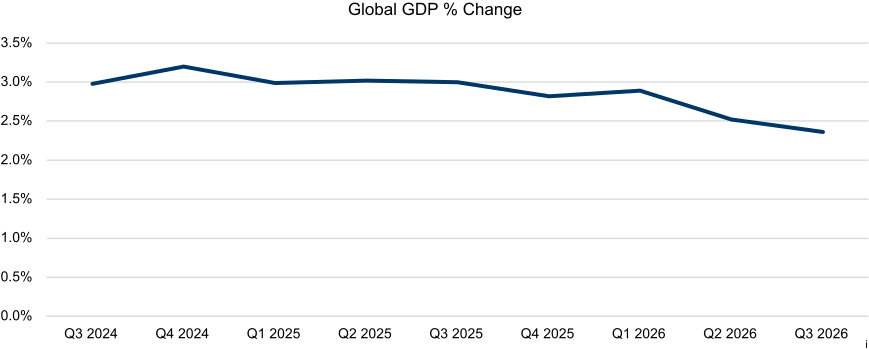
The global economy remained uncertain but resilient in Q3 2026. Several factors contributed to global economic uncertainty in the quarter, including the conflict in the Middle East and the announcement of additional U.S. tariffs. Although some crude oil shipments through the Strait of Hormuz continued, transporting energy out of the region became more costly,ii driving Brent Crude prices to $115.91 by the end of Q3.iii In addition, the U.S. implemented a new round of tariffs in July covering 99.4 percent of U.S. imports.iv Together, these factors put upward pressure on global inflation, which constrained consumer spending growth and prompted some central banks to raise interest rates.v

Still, the global economy continued to grow during the quarter. GDP grew 2.4 percent year over year,vi while OECD unemployment remained stable.vii AI-related capital investment also continued to drive global economic activity.viii

For these reasons, economists expect global growth to continue through the remainder of 2026 and into 2027, despite the uncertainty. The IMF’s World Economic Outlook projects global GDP growth of 3.1 percent in 2026 and 3.4 percent in 2027.ix Oxford Economics expects more modest (but still respectable) growth of 2.6 percent in 2026 and 2.8 percent in 2027.x

With steady economic growth and the wealth creation that accompanies it, the business jet market remains well positioned for the remainder of 2026.

FLIGHT OPERATIONS

2-flight-ops-xi

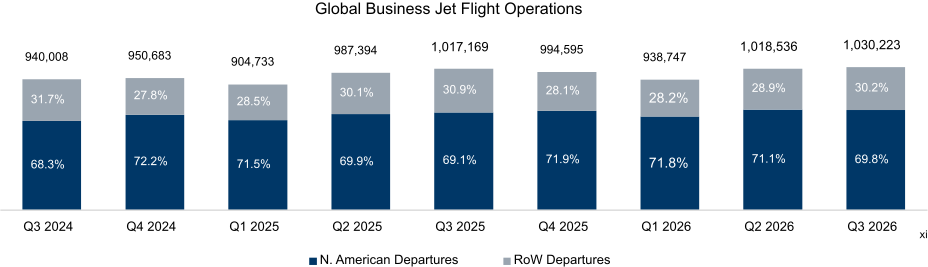
Demand for business aviation has grown since mid-2024. In Q3 2026, business jet departures increased 1.3 percent year over year. North America led global growth in flight activity, with departures rising 2.4 percent. In contrast, regional geopolitical events in the Middle East contributed to a 1.2 percent year-over-year decline in departures across the rest of the world. Fractional operators remained the leading growth segment, posting solid gains throughout the quarter. Departures also increased 1.1 percent from Q2 2026, consistent with historical seasonal patterns following strong spring travel activity.

Year-to-date departures were up 2.7 percent through the end of September 2026. North America led this growth, with departures increasing 3.8 percent compared with the same period in 2025, while flight activity in the rest of the world remained roughly in line with 2025 levels.

This strong performance reflects the expansion of the business aviation user base over the past five years. Supported by the industry’s core value propositions—personal safety, flexibility, productivity, and comfort—and bolstered by continued global wealth creation, flight operations are expected to remain steady through the remainder of 2026.

OEM BACKLOGS

OEM-Backlog


OEM backlogs rose 20.4 percent year over year in Q2 2026, reaching $66.8 billion. Aggregate Q2 2026 deliveries were nearly even with Q2 2025. Following year-over-year increases in Q1, total first-half deliveries for the five main OEMs increased 4.5 percent year over year as OEMs continued to address supply chain and labor issues. Even as deliveries remained at a healthy level, strong demand for new business jets persisted. Orders grew in Q2 supported by activity from both fleet operators and private users, resulting in an industry-wide book-to-bill ratio above 1-to-1. With lead times among major manufacturers remaining between 18 and 26 months on average (and even longer for some models), OEMs can sustain current delivery levels throughout the remainder of 2026 while maintaining a healthy backlog.

TRANSACTIONS ($ VOLUME)

4-trans-volume-xiii


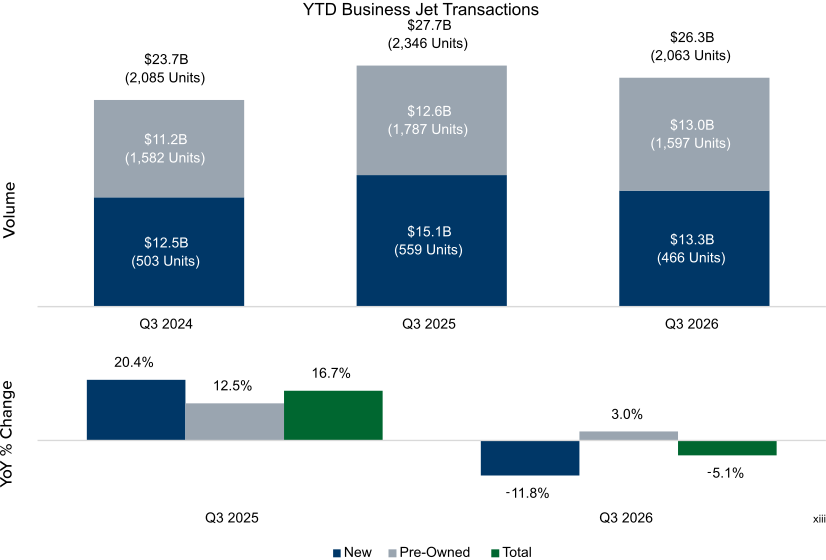
Note that the latest figures from 2026 reflect preliminary data and may increase as more transactions are reported to data providers.

Based on available data, year-to-date transaction dollar volume through Q3 2026 decreased 5.1 percent from the same period in 2025. The downturn follows an active end to 2025, when Q4 transaction dollar volume increased 19.3 percent year over year.

However, analysis of other data sources, including OEM reports and Global Jet Capital’s field intelligence, indicates that delays in official data reporting may account for a portion of the decline. As additional transactions are reported, we expect 2026 results to align more closely with historical trends.

As reported, new deliveries declined during the first three quarters of 2026, with unit volume falling 16.6 percent and dollar volume decreasing 11.8 percent. As additional transactions are reported, however, we expect final 2026 new-delivery transaction data to be largely on target. OEM commentary during the quarter reflected continued progress in resolving the remaining isolated supply chain and labor constraints on new aircraft production.

Through Q3 2026, year-to-date pre-owned transaction unit volume was down 10.6 percent, while dollar volume was up 3.0 percent year over year. The divergence was attributable to continued stability in aircraft values and strong demand for heavy jets.

The decline in unit volume was driven by delayed transaction reporting and an unfavorable comparison with an unusually active start to 2025. Based on historical reporting lags, we estimate that pre-owned transactions declined roughly 2 percent year to date.xiv Much of this decline reflects year-over-year weakness in Q1. In Q1 2025, pre-owned unit volume increased 37.4 percent year over year as some buyers accelerated transactions to close deals ahead of anticipated U.S. tariffs. Without that time pressure, Q1 2026 transaction unit volume declined 16.7 percent from the prior-year period. While that effect has moderated as Q2 and Q3 comparisons have normalized, it continues to weigh on year-to-date results. Market activity remains healthy, and transactions are expected to continue at a steady pace through the remainder of the year.

FOR SALE INVENTORY

5-aircraft-avail-sale-xv

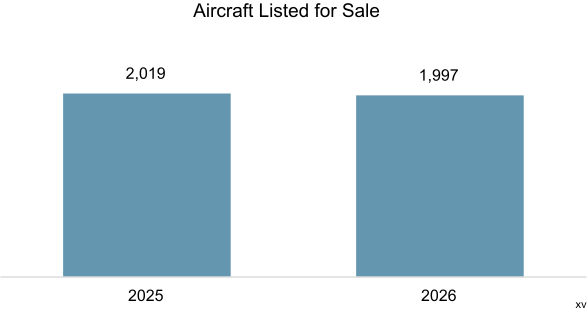
Driven by a decline in listings of newer aircraft, business jet listings decreased 1.1 percent year over year through the end of Q3 2026, following a 5.8 percent decline in 2025.

Following a decline in public listings in 2021, sellers returned to the public market from 2022 through mid-2024, bringing listings back in line with historical norms. Beginning in mid-2024 and continuing through 2025, strong market activity drove listings down again, resulting in the sharp decline noted above. In 2026, listings fluctuated from month to month but remained roughly in line with 2025 levels on a year-to-date basis.

While overall listing levels were similar in 2025 and 2026, the mix by aircraft age shifted. Listings for aircraft aged 12 years and younger fell 10.8 percent year to date, while listings for aircraft aged 13 years and older grew 3.1 percent. The growing share of older aircraft represents a return to a long-term industry trend. Older jets accounted for 58.4 percent of total listings in 2019, rising to 68.3 percent by 2022. After a brief period of stability, their share rose to 72.7 percent by the end of Q3 2026.

6-percentage-biz-jet-fleet-xvi


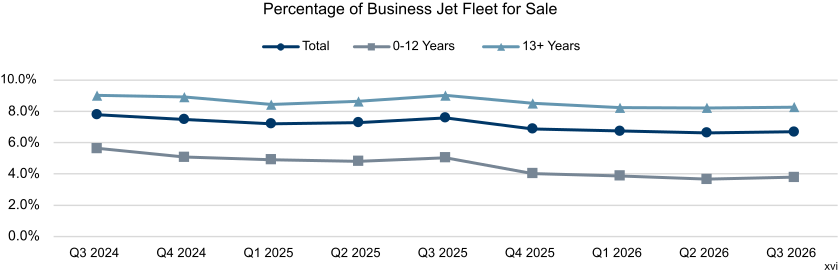
Aircraft availability ended Q3 at 6.7 percent of the fleet, a slight increase from 6.6 percent at the end of Q2 but a significant decline from 7.6 percent at the end of Q3 2025.

Availability increased slightly across all age groups on a quarter-over-quarter basis in Q3. Availability of aircraft aged 12 years and younger rose from 3.7 percent to 3.8 percent, while availability of aircraft aged 13 years and older increased from 8.2 percent to 8.3 percent. However, availability in both age groups remained well below year-ago levels. Furthermore, the modest quarter-over-quarter increase appears to represent stabilization at tight levels rather than loosening supply, with the gap between newer and older segments underscoring continued scarcity for high-quality young aircraft.

For younger aircraft, low inventory also reflects lower OEM production rates, particularly during 2020–21. The combination of constrained supply and strong demand positions the business jet market for a solid end to 2026, with availability remaining below historical averages.

RESIDUAL VALUE

7-aircraft-value-xvii


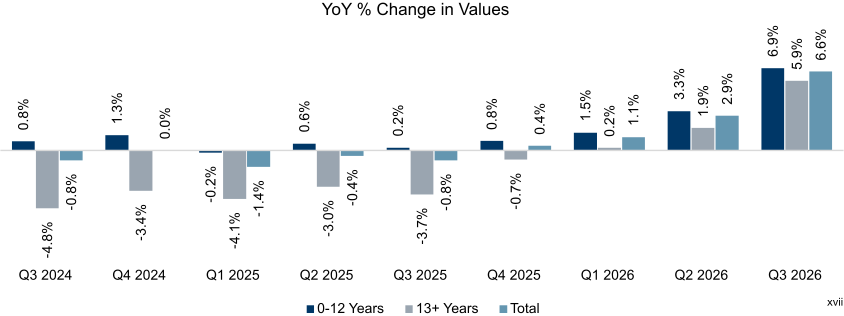
The above chart compares the year-over-year percentage change in the bluebook value of like-aged aircraft over time (e.g., the difference between the value of an eight-year-old aircraft from one year to the next). Global Jet Capital analyzes a basket of aircraft as a proxy for the overall market. Values vary on a model-by-model basis and observed increases or decreases in value are not necessarily applicable to any specific aircraft make/model. For the value of a specific aircraft, please contact a licensed aircraft appraiser.

In Q3 2026, aircraft bluebook values for like-aged aircraft increased 6.6 percent compared with Q3 2025, reflecting appreciation on a year-over-year basis.

Value trends continued to vary across the installed base. Values for aircraft aged 12 years and younger increased 6.9 percent year over year in Q3 2026, compared with 5.7 percent for aircraft aged 13 years and older. While younger aircraft outperformed older aircraft throughout the period shown, the improvement was broad-based.

It is worth noting that business jets are depreciating assets, and a steady decline in an aircraft’s price over its lifespan is to be expected. Current developments are supported by stable demand as well as a broader industry context of new aircraft pricing and wait times. Longer term, we can expect historical depreciation trends to resume, resulting in stable (versus rising) values for like-aged aircraft. In addition, values vary by aircraft segment and model, and future trends will depend on the balance between supply and demand.

\ CONCLUSION

The business jet market remained healthy in Q3 2026.

The economy remained stable despite geopolitical uncertainty. Against this backdrop, business jet departures continued to grow, led by North America. OEM backlogs also remained high. While transactions declined, this was largely due to reporting delays and a difficult prior-year comparison. Activity is expected to remain stable through the remainder of the year. Aircraft availability also remained low, driving appreciation in the value of like-aged aircraft. Together, these factors place the business jet market in a strong position, with activity expected to remain positive for the remainder of the year.


DID YOU KNOW AN OPERATING LEASE PROVIDES AN OWNERSHIP EXPERIENCE WITHOUT BEING IN THE FULL BUSINESS OF OWNING AN AIRCRAFT?

GLOBAL JET CAPITAL RECENT TRANSACTIONS

Global Jet Capital is a leader in the business jet financing market, providing leases and loans for both new and used aircraft. Our clients are diverse but all value flexible financing solutions for their aircraft. Below is a brief overview of a few recent transactions that Global Jet Capital has facilitated.

RECENT TRANSACTIONS

Jet-icon
Jet-icon

RECENT TRANSACTIONS

Seeking a newer aircraft to better align with their long-term growth, an existing client turned to Global Jet Capital for a comprehensive aircraft replacement solution.

With high demand and constrained availability for their favored new aircraft type, the client needed an experienced financing partner capable of closing rapidly once the ideal asset was located. GJC leaned into our deep relationship with the client and our recent transaction history to accelerate every phase of the deal. Drawing on our expertise and our understanding of the client’s preferences, we streamlined the aircraft replacement process to meet their urgent deadline. Global Jet Capital delivered a comprehensive, flexible solution addressing the disposition of the client’s existing aircraft while seamlessly transitioning into their new aircraft. Our tailored approach enabled the client to secure a highly sought-after aircraft type while remaining focused on their broader business objectives.


AIRCRAFT CLASS
Ultra Long Range

NEW/PRE-OWNED
New

REGION
APAC

FINANCIAL PRODUCT(S)
Finance Lease


RECENT TRANSACTIONS

Jet-icon
Jet-icon

RECENT TRANSACTIONS

A valued existing client was planning to acquire a new aircraft and sought a financing solution that would preserve their capital throughout the purchase process while supporting their long-term growth objectives.

The client recognized the value of a financing partner that provides both pre-delivery payments and long-term financing while aligning with their broader corporate financial objectives. Leveraging our longstanding relationship and deep expertise in business aviation finance, Global Jet Capital tailored a PDP facility optimizing the client’s cash flow and reducing the client’s capital required throughout the acquisition process. The PDP facility transitioned seamlessly into long-term financing when the aircraft delivered, providing a single, coordinated solution from initial commitment through aircraft acceptance. By providing liquidity and financing certainty across the entire transaction, GJC enabled the client to secure a new aircraft without diverting capital from its core business. The result was a strategic financing solution aligning with both the client’s immediate acquisition needs and its long-term growth plans.

AIRCRAFT CLASS
Super Mid

NEW/PRE-OWNED
New

REGION
Americas

FINANCIAL PRODUCT(S)
PDP w/ Operating Lease


RECENT TRANSACTIONS

Jet-icon
Jet-icon

RECENT TRANSACTIONS

In a competitive aircraft market, this client recognized that financing certainty would be essential to making compelling offers and moving forward quickly when a suitable aircraft became available.

Global Jet Capital provided the certainty, support, and flexibility needed to strengthen the client’s position throughout the acquisition process. Leveraging our dedicated aviation finance model and asset-focused approach, we delivered a tailored finance lease aligned with the client’s objectives and acquisition strategy. This specialized expertise enabled us to provide efficient access to capital while structuring a solution that met the client’s unique needs. The resulting solution allowed the client to secure the aircraft while limiting the cash committed to the transaction, preserving capital for reinvestment in their core business and supporting their broader growth objectives.


AIRCRAFT CLASS
Ultra Long Range

NEW/PRE-OWNED
Pre-Owned

REGION
Americas

FINANCIAL PRODUCT(S)
Finance Lease

Notes

iOxford Economics,  iiOxford Economics,  iiiU.S. Energy Information Administration,  ivOffice of the U.S. Trade Representative,  vOxford Economics,  viOxford Economics,  viiOECD,  viiiOxford Economics,  ixIMF World Economic Outlook, October 2026,  xOxford Economics,  xiWingX and Global Jet Capital Analysis,  xiiCompany financial reports and GJC Analysis.,  xiiiJetNet and Global Jet Capital Analysis. Units are in parentheses.,  xivBased on JetNet analysis of historical reporting lags,  xvAmstat and Global Jet Capital analysis,  xviJetNet and Global Jet Capital analysis  xviiAircraft Bluebook and Global Jet Capital analysis 

LinkedIn-logo